 Docs Portal
Entities and Relationships
Entities and Relations in Expert Center
This guide introduces the core concepts of entities and relations in Expert Center, explaining how raw building data transforms into a unified knowledge graph.
Overview
Expert Center processes building data through several stages, creating different types of entities and relationships along the way. Understanding these concepts is essential for effectively using Expert Center to build your knowledge graph.
Source Entities: Your Starting Point
Source Entities are the foundation of your knowledge graph. These are the original entities that exist in your building's data sources (connectors).
Every Source Entity represents something real in your building, such as a:
- control point
- device
- equipment
- space
For example:
1VAV-101.DMPR_POS
Labeling: Teaching the AI
Raw Source Entities are like unlabeled boxes in a warehouse - you know they exist, but not what they are or how they relate to each other. Expert Center uses a powerful AI-assisted approach to transform this raw data into meaningful building intelligence.
The process works in two stages: first, human experts label a subset of entities to create training examples, then AI learns from these examples to automatically process the rest. This combination of human expertise and AI scalability enables you to build comprehensive knowledge graphs from thousands of data points.
Labeled Source Entities
When human experts manually classify Source Entities during the Label step, they become Labeled Source Entities. A Labeled Source Entity contains three key components:
- Entity Type: The classification of the Source Entity (e.g., "Damper_Position")
- Derived Entities: New entities extracted from the Source Entity's patterns
- Derived Relations: Relationships connecting the Source Entity to its Derived Entities
Let's explore each component:
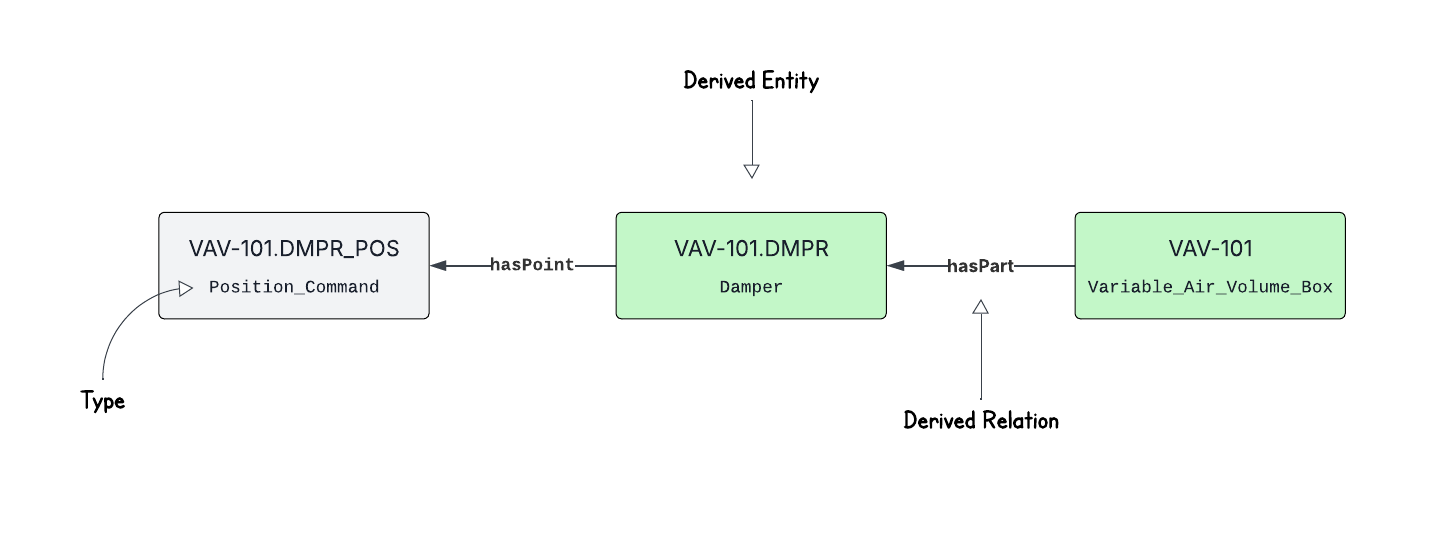
Derived Entities from Labeling
When labeling
1VAV-101.DMPR_POS
- VAV-101: A Variable Air Volume box
- VAV-101.DMPR: A Damper
These become Derived Entities - entities manually created by experts who understand the building systems.
Derived Relations from Labeling
Experts also establish relationships between the Source Entity and Derived Entities using "SELF" notation:
- Copy: The damper has this position point
1VAV-101.DMPR hasPoint SELF - Copy: VAV-101 contains a damper
1VAV-101 hasPart VAV-101.DMPR
These Labeled Derived Relations create the hierarchical structure of the current Source Entity and its Derived Entities.
Inferred Source Entities
After learning from Labeled Source Entities, the AI model automatically processes remaining Source Entities, creating Inferred Source Entities. Like their labeled counterparts, Inferred Source Entities contain:
- Type: The classification predicted by AI
- Derived Entities: New entities automatically extracted by AI
- Derived Relations: Relationships automatically predicted by AI
The model:
- Recognizes patterns from labeled examples
- Applies these patterns to new entities
- Provides confidence scores for predictions
- Scales the labeling process across thousands of entities
For example, after learning from
1VAV-101.DMPR_POS
1VAV-102.DMPR_POS
- Infer its type as "Damper_Position"
- Create derived entity "VAV-102"
- Establish the relationship Copy
1VAV-102 hasPoint SELF
Unified Entities: Creating a Ground Truth
The final step addresses a common challenge: the same physical equipment often appears differently across various data sources. A single air handler might be:
- Copyin the BMS
1AHU01 - Copyin mechanical drawings
1Air Handler 1 - Copyin maintenance records
1AC-1
Unified Entities solve this by creating a connector-agnostic representation of real-world entities. They:
- Can contain multiple Source/Derived entities from different connectors
- Provide a single identity for each piece of equipment
- Allow users to choose the final name in the knowledge graph
Instead of seeing three different air handlers in your graph, you see one Unified Entity (which you might name "AHU-01") that encompasses all representations.
The Complete Picture
Understanding these concepts helps you see how Expert Center transforms raw building data:
- Source Entities arrive from your connectors as raw, unclassified data
- Labeling by human experts creates training examples with types, derived entities, and relations
- Processing by AI automatically scales this enrichment process across all remaining entities
- Derived Entities and Relations extract implied equipment and build system hierarchies
- Unified Entities deduplicate entities across connectors into single real-world representations
The result is a clean, unified knowledge graph that accurately represents your building's systems and their relationships, ready for analytics and operations.
Next Steps
-
Learn about the labeling process to create high-quality training data
-
Understand inference and processing to scale your knowledge graph
-
Explore unification to merge entities across connectors